



























Artificial Intelligence (AI) is quickly becoming part of everyday business conversations. For many businesses, the focus is often on productivity, automation and how tools such as Microsoft CoPilot can help people work faster and smarter.
AI can help teams summarise information, analyse data, improve customer service, automate repetitive tasks and support better decision making. There is another side to this conversation, though, and business leaders cannot afford to ignore it.
Why AI is changing the cyber threat landscape
The National Cyber Security Centre recently reported on a warning from the Five Eyes intelligence alliance, made up of the UK, US, Canada, Australia and New Zealand, that advanced AI models could significantly increase cyber capability within months, not years. The warning was not just aimed at governments or critical infrastructure providers, it was a message for business leaders too.
What’s becoming clear is AI may make attackers faster, more capable and more efficient. That means organisations with weak cyber hygiene, exposed systems, poor patching, legacy infrastructure or uncontrolled access are likely to become easier targets.
Building cyber resilience in the age of AI
There’s temptation to believe that AI powered cyber threats require an entirely new approach to security. In reality, the most effective defence still begins with the fundamentals.
What has changed is the pace. AI lets attackers identify vulnerabilities faster, write more convincing phishing emails and scan for exposed systems at scale. This means the window for businesses to respond is much smaller.
This puts pressure on areas that many businesses already know need attention:
- Are systems patched quickly enough?
- Are old or unsupported devices still in use?
- Are all users protected by multi-factor authentication?
- Are administrator accounts properly controlled?
- Are backups tested and recoverable?
- Would the business know what to do in the first 24 hours of a cyber incident?
Questions like this aren’t new, but AI makes the answers more important.
For most organisations, cyber risk is no longer just an IT issue. It affects operations, finance, reputation, insurance, compliance and customer trust.
A ransomware incident, business email compromise, data breach or system outage can quickly move from a technical problem to a board level crisis. The question is not simply “could we be attacked?” the more useful question is, if something happened tomorrow, “how exposed would we be and how quickly could we recover?”
Cyber hygiene matters. It is the foundation that reduces the likelihood of an incident and limits the impact if one occurs.
Good cyber hygiene does not mean buying every security product available. It means having a clear, managed and measurable approach to the controls that matter most:
- Secure identity and access management
- Multi-factor authentication across key systems
- Regular patching and vulnerability management
- Endpoint protection and detection
- Backup and recovery testing
- Removal or isolation of unsupported systems
- User awareness and phishing resilience
- Secure Microsoft 365 configuration
- Incident response planning
- Regular reporting to leadership
These areas may not sound as exciting as AI, but they are exactly the controls that help businesses use AI safely.
Is your Microsoft 365 environment ready for CoPilot?
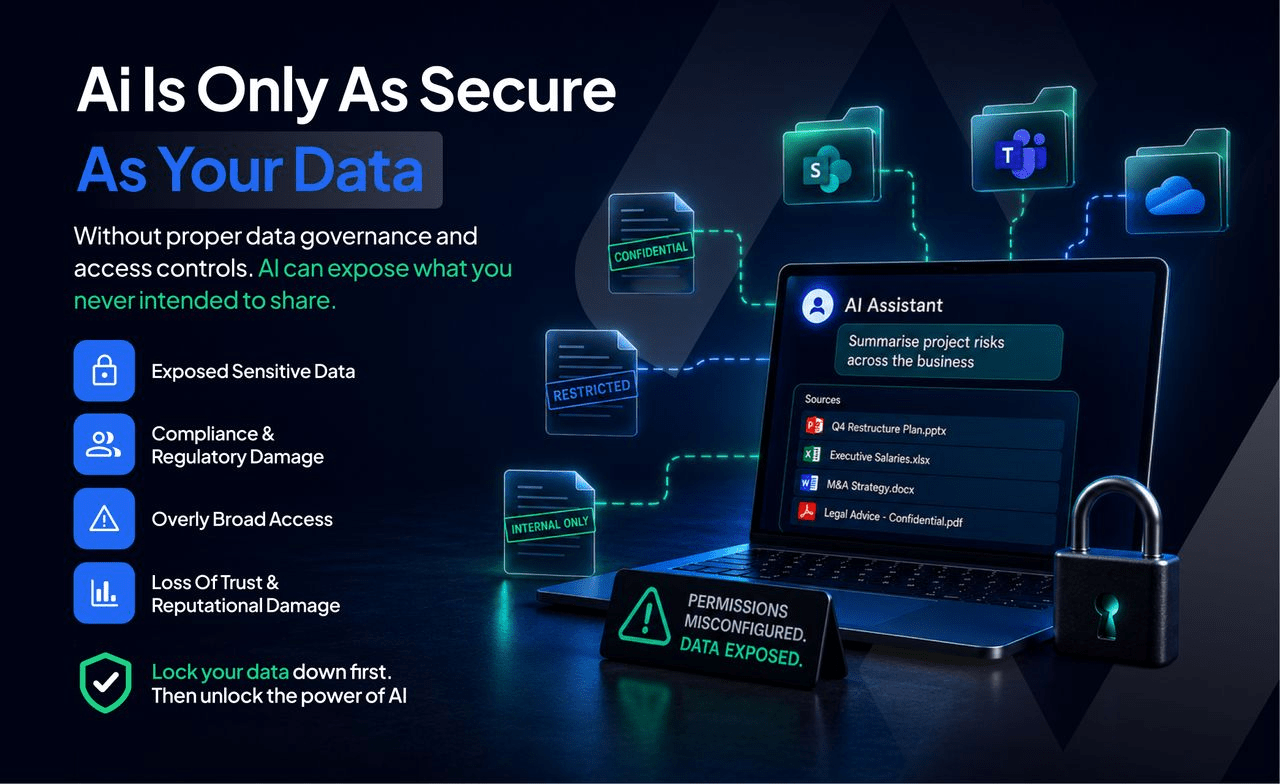
As more businesses explore Microsoft CoPilot and other AI tools, the importance of data and governance and permissions becomes even greater.
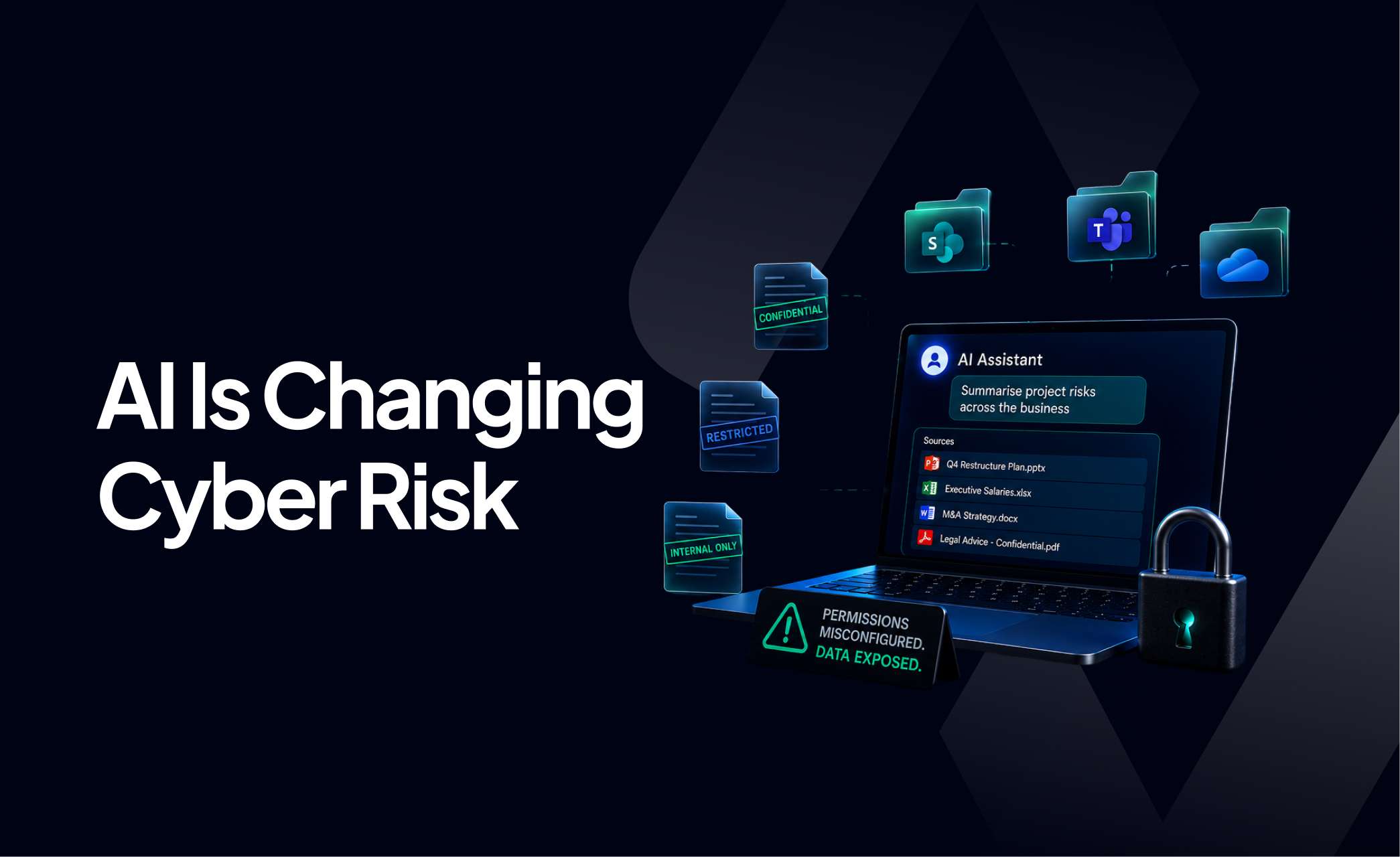
AI tools are powerful because they can surface, summarise and connect information quickly, but that also means they can expose existing weaknesses. If documents are overshared, permissions are poorly managed or sensitive data is stored in the wrong place, AI can make those issues more visible.
Before rolling out AI across the business, leaders should be asking:
- What data can users currently access?
- Is sensitive information labelled and protected?
- Are SharePoint, Teams and OneDrive permissions under control?
- Are inactive users and legacy accounts removed?
- Are privileged accounts properly secured?
- Are there clear business policies for acceptable AI use?
- Do staff understand what data should and should not be entered into AI tools?
AI readiness is not just about licenses and training, it is about making sure that the environment is secure, structured and governed before AI is scaled.
7 Steps to prepare your business for AI adoption
The NCSC article and wider Five Eyes warning should not be read as another reason to delay AI adoption. Instead, it should be a prompt to adopt AI responsibly.
With the fundamentals above in place, here’s the process to follow before scaling AI across the business:
- Identify what systems, users and data are most critical to the business.
- Check whether core cyber controls are in place and working.
- Review Microsoft 365 permissions, sharing and identity security.
- Remove or manage legacy systems and unsupported software.
- Test backup and recovery processes.
- Create a clear written policy for safe AI use, detailing what employees can and cannot enter into AI tools.
- Give leadership regular visibility of cyber risk and progress.
AI will continue to move quickly. Attackers will use it, vendors will build it into products, and employees will find ways to use it whether organisations have a formal strategy or not.
The best response is not to stand still, it is to move forward with control.
Working with Netcentrix to secure the foundations before you scale AI
At Netcentrix, we believe AI should be seen as an opportunity, not something to fear. Used properly, it can help organisations improve productivity, reduce manual effort and create better outcomes for staff and customers.
However, AI adoption should not happen in isolation.
The businesses that benefit most will be the ones that combine innovation with strong foundations. That means understanding their current security posture, addressing the basics and giving leadership clear visibility of risk.
Our approach is to help our customers join up three connected conversations:
- Productivity – how can AI and modern workplace tools help people work better?
- Security – are identities, devices, data and systems protected?
- Resilience – can the organisation continue operating and recover quickly if something goes wrong?
This is where services such as N-Sure Managed IT Support and N-Force Cyber Security come together. Managed support helps keep the environment controlled, maintained and visible. Cyber security services help strengthen the areas attackers are most likely to target, including identity, endpoint protection, Microsoft 365 security, compliance and recovery.
For customers considering Microsoft CoPilot or wider AI adoption, the starting point should be a practical readiness conversation. Not a technical deep dive for its own sake, but a clear review of risk, data, controls and business priorties.
Is your business ready for AI driven cyber threats?
AI is changing what is possible for businesses and for cyber attackers. That does not mean every organisation needs to panic but it does mean cyber hygiene can no longer be treated as a background IT task.
The basics matter more than ever. Before scaling AI, businesses should ask the simple question on whether they are confident that their identities, devices, data and recovery plans are ready for a faster moving threat landscape.
If you are reading this because you have just experienced a cyber incident and are unsure how to deal with the cyber attack, stop now and contact Netcentrix immediately.
Or if you are looking for a managed cyber security provider to help you understand your organisation’s current security posture, get in touch with the Netcentrix team. We will review your environment, identify gaps and help you build stronger protection for the years ahead.
Call us on 0333 003 0560 or complete our contact form and we will be in touch.